
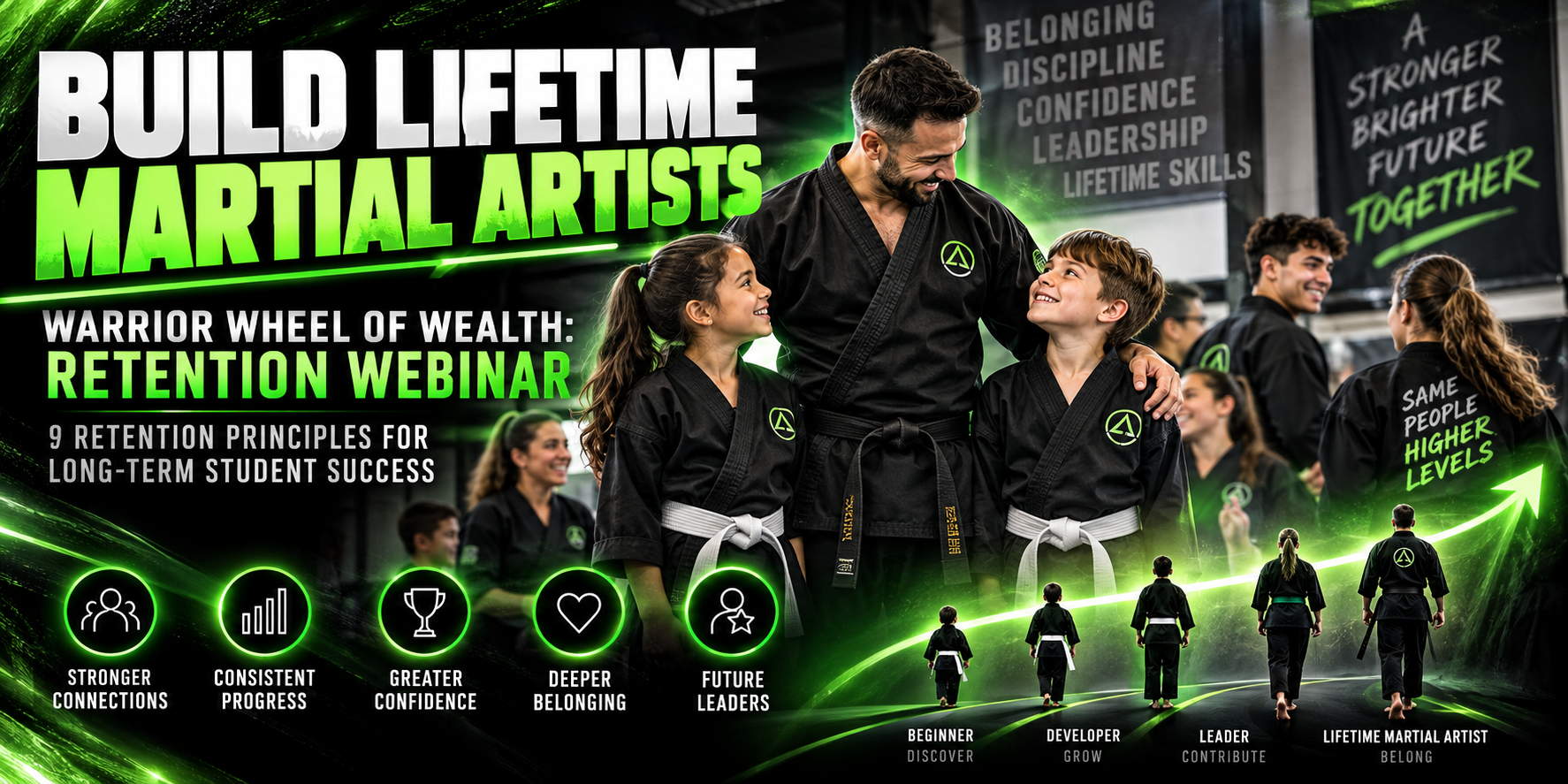
Wheel of Wealth: Retention NOTES
🥋 Warrior Wheel of Wealth
Retention Webinar
Presented by Grand Master William Clark
Warrior Success Systems
“For me, there’s only two things. There’s how many people can I enroll, and can I keep people for 10 years?”
🎯 Leadership Focus: Building Lifetime Martial Artists
Grand Master Clark challenged martial arts school owners to rethink retention. Rather than viewing students as short-term memberships, instructors should develop a long-term plan that keeps students motivated, connected and progressing for 10 years or more.
His central message was that retention begins before enrollment and must be reinforced through every class, relationship, milestone and future goal.
The webinar explored the foundations of retention and nine specific strategies for developing lifetime martial artists.
The Foundation: Retention Begins Before Enrollment
Before introducing the nine retention strategies, Grand Master identified four foundational considerations.
Four foundations of retention
- Convenient location
Grand Master described concentrating most local marketing within approximately three miles of a school, except in areas where families routinely travel farther. Long journeys can become a barrier to consistent attendance.
- A schedule designed around families
Offer practical choices rather than restricting students to one available class. The rotating curriculum can help schools provide more training options while maintaining consistent instruction.
- Instructors students want to train with
Grand Master emphasized charisma, enthusiasm and communication. An instructor’s ability to connect with students and parents is an important part of the experience.
- A curriculum designed for long-term development
Avoid teaching everything too quickly or allowing training to become repetitive. Introduce new material and experiences progressively so students have opportunities to develop over many years.
The foundation of the system is a long-term commitment shared by the instructor, student and family. The objective is to develop a student who continues learning, progressing and discovering new goals throughout their martial arts journey.
The Nine Principles of Retention
1️⃣ Set the Next Goal Before the Current Goal Ends
Never allow a student to complete a program without understanding what comes next.
Grand Master emphasized that goals create the motivation to continue training.
A student’s next goal could include earning a Black Belt, increasing training frequency, joining Advanced Training, competing, entering Leadership or Coaching, or pursuing higher degrees.
Instructors should introduce the next goal before the current one is completed.
Key principle: A student should always have a reason to return and something meaningful to work toward.
2️⃣ Use Progress Checks Consistently
Progress Checks should strengthen relationships, celebrate development and create conversations about future goals.
Grand Master recommended conducting Progress Checks at defined milestones, including approximately every 30 classes in the Warrior system, as well as before or after major events and graduations.
During these conversations, instructors should:
- Ask students and parents about their experiences.
- Discuss what the instructor has observed.
- Recognize measurable progress.
- Address concerns before they become reasons to quit.
- Discuss the student’s next goal.
Progress Checks are not simply sales presentations.
Key principle: Build relationships and communicate progress long before a family considers leaving.
3️⃣ Discover Every Student’s Hot Button
Not every student is motivated by the same aspect of martial arts.
One student may discover a passion for competition, another for teaching, and another for weapons, self-defense or advanced techniques.
Grand Master shared an example of a young competitor whose confidence and enthusiasm transformed when he performed a weapons routine.
The lesson is that instructors should provide opportunities for students to experience different aspects of martial arts.
These experiences help reveal what excites each individual.
Key principle: Find the experience that makes each student passionate about training.
4️⃣ Create Belonging During the First 30 Days
The first month of training should establish an emotional connection to martial arts and the school.
Grand Master challenged instructors to introduce new students to their classmates, help them discover shared interests and create opportunities for friendships.
He also encouraged existing students to welcome newcomers and introduce themselves to their parents.
Every student should receive an enthusiastic greeting whenever they arrive.
The central objective of the first 30 days is not simply to teach techniques.
It is to help students learn to love martial arts.
Celebrate their earliest accomplishments and help them recognize their improvement.
Key principle: Make students feel successful, welcomed and connected from their very first class.
5️⃣ Make Every Class an Experience Worth Repeating
At the end of every class, students make another decision about whether they want to return.
Grand Master described martial arts instruction as edutainment: the combination of education and entertainment.
Essential techniques still require repetition, but instructors can change how students experience that repetition.
Vary equipment, drills, training scenarios and classroom arrangements. Introduce something exciting and give students a preview of what they will learn next.
He compared this to movie previews, which generate anticipation for a future experience.
Key principle: Every class should provide a rewarding experience and a reason to look forward to the next one.
6️⃣ Build Relationships With Parents
A student’s enthusiasm alone may not be enough to sustain a long-term membership.
Parents need to understand the value of training, recognize their child’s progress and feel connected to the school.
Grand Master emphasized that instructors must communicate the progress parents may not immediately recognize.
During Progress Checks, explain the improvements you have observed, discuss future development and connect martial arts training to the family’s original goals.
He also encouraged schools to invite interested parents to participate in training.
Key principle: Don’t assume parents can see the progress you see. Communicate it consistently.
7️⃣ Make Every Student Feel Important
Grand Master challenged instructors to make students feel valued, recognized and needed.
Use their names. Make eye contact. Recognize their accomplishments. Personally invite them to training opportunities.
He also emphasized giving students meaningful responsibilities.
Students might greet newcomers, assist with equipment, participate in Coaching or contribute to special events.
A personal invitation is especially powerful because it communicates that the instructor specifically wants that student to participate.
Grand Master summarized the underlying question:
“Do I matter to the instructors?”
Key principle: Give every student a reason to feel that their presence makes a difference.
8️⃣ Use Events to Build Belonging and Create the Next Opportunity
Tournaments, seminars, special training sessions and other events should strengthen the student’s relationship with the school.
Grand Master encouraged instructors to invite specific students personally rather than relying exclusively on general announcements.
He emphasized the relationship-building benefits of attending and traveling to events together.
Shared experiences outside regular classes create opportunities for conversations, friendships, motivation and personal development.
Instructors should also give students responsibilities at events, including those who are not competing or testing.
Afterward, use Progress Checks to discuss their experiences and establish the next goal.
Key principle: Events should create stronger relationships and a reason to continue training.
9️⃣ Create a Clear, Long-Term Student Pathway
Students should understand that earning a Black Belt represents an important milestone, not necessarily the end of their martial arts journey.
Grand Master described a development pathway that can include:
Example long-term student pathway
- Basic Training
Establish fundamental skills, relationships and an initial Black Belt goal.
- Advanced Training
Introduce additional techniques, weapons and board breaking.
- Leadership
Develop presentation skills, confidence and experience with demonstrations.
- Coaching and Competition
Provide opportunities to teach, accept responsibility and explore competitive goals.
- Higher Degrees and Continued Development
Establish new technical, athletic and personal development goals beyond First Degree Black Belt.
This is an example pathway rather than a requirement that every student follow the same sequence.
Grand Master’s challenge was to review the entire student roster and determine whether every student has a clear next step.
Importantly, students and their families must understand that pathway too.
Key principle: If instructors cannot identify what’s next for a student, the student may not see a compelling reason to continue.
💡 Key Takeaways
The webinar reinforced one central idea: retention is an ongoing process, not an activity reserved for membership renewals.
Strong retention requires convenient training opportunities, instructors who build meaningful relationships, engaging classes, consistent progress communication, personal recognition and clearly defined long-term goals.
Grand Master encouraged participants not to attempt every improvement simultaneously. Instead, each school should identify at least one strategy it can implement immediately.
⚔️ Warrior Retention Action Plan
Retention implementation checklist
0 of 9
Review location and scheduling convenience from a family’s perspective.
Identify the next meaningful goal for every active student.
Schedule Progress Checks at appropriate milestones and after major events.
Create opportunities for students to try programs and discover their individual interests.
Establish a structured welcome experience for each student’s first 30 days.
Prepare something memorable and a preview of what’s next for every class.
Communicate individual student progress directly to parents.
Personally invite students to events and give them meaningful responsibilities.
Review the school’s long-term development pathway and make sure students understand their next step.
💬 Quotes of the Webinar
“Big goals give me a reason to train.”
“They’ve got to learn to love martial arts.”
“We’re the edutainment business. Education and entertainment.”
“Do I matter to the instructors?”
“You have to know what’s next for them.”
🥋 Final Warrior Challenge
Review your student roster and ask three questions about every individual:
What motivates this student? What makes this student feel connected? What is this student’s next meaningful goal?
If you don’t know the answers, make it a priority to find out through conversations and Progress Checks.
Choose one retention strategy from this webinar and begin implementing it immediately.
Create the connection. Discover the passion. Establish the next goal. Build lifetime martial artists.