
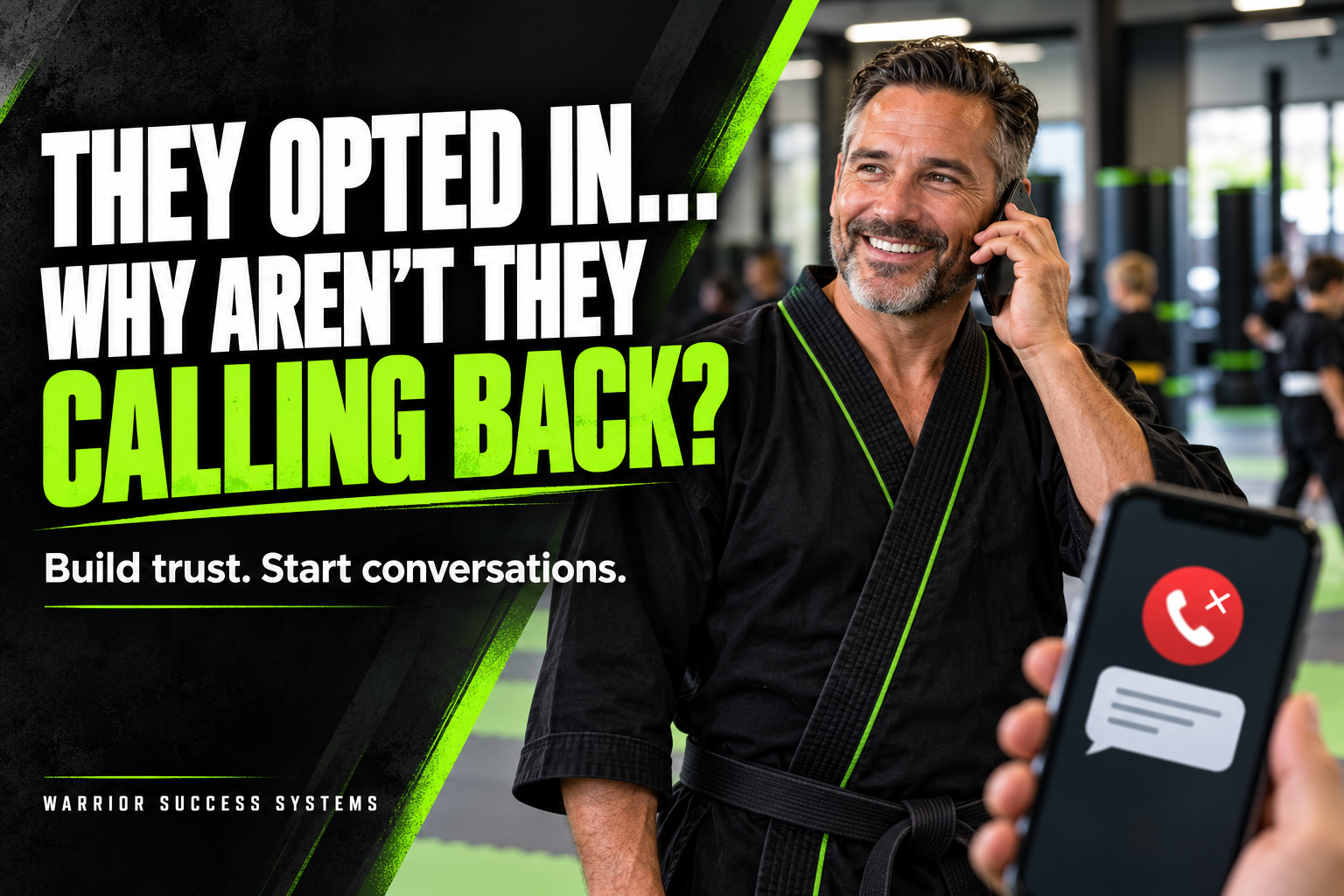
Turning Lead Follow-Up Into Real Conversations – Webinar REPLAY & Notes
WARRIOR LEADERSHIP BRIEFING
Webinar Notes: Turning Lead Follow-Up Into Real Conversations
Presenter: Master Fred Mertens
Leadership Guidance: Grand Master William Clark
Leadership Focus: Respond quickly, build trust, and use consistent personal follow-up to help prospects take the next step.
1. The First Call Is an Invitation to Connect
A prospect requesting information has expressed interest. Our first responsibility is to learn what prompted that interest and help them determine where to start.
“The first call is not a sales call. It’s an invitation to start a conversation.” — Master Mertens
- Introduce yourself and your role clearly.
- Explain how you can help the parent or adult prospect.
- Focus on their goals before discussing memberships.
- Make the next step easy: return the call or text a convenient time to talk.
Key principle: The first message should create confidence that the person calling can help.
2. Respond Quickly and Use the Double Dial
Master Mertens’ target: Respond to a new inquiry within five minutes whenever possible.
His recommended initial calling process:
- Call the prospect.
- If voicemail answers, hang up without leaving a message.
- Wait 20–30 seconds and call again.
- If the second call goes unanswered, leave the first voicemail.
- Follow with a short personal text, and consider a video.
Master Mertens reported that the double dial improved answer rates in his experience. He also reminded everyone that many calls will still go unanswered.
Staff takeaway: An unanswered call is a reason to follow the process, rather than assume the prospect has lost interest.
3. First Message: Establish Who You Are and How You Can Help
The first message should identify the school, acknowledge the inquiry, and offer guidance.
Sample wording adapted from the webinar:
“Hi, [Name]! This is [Your Name], the [Your Role] at [School] in [Location]. You reached out through [Source] about our children’s martial arts program, and I wanted to personally get back to you. I’m the person who can help you determine which program and class would best fit your child. Give me a call back, or even easier, text me the best time to reach you and I’ll call. I look forward to speaking with you!”
- Use the prospect’s name.
- Connect the message to their actual inquiry.
- Establish your ability to guide them.
- End with a simple response request.
Key principle: Introduce yourself as a helpful, knowledgeable person and deliver the message warmly.
4. Second Message: Learn About the Child and the Parent’s Goals
The second call should move the conversation forward. Repeating the first message adds little value.
Explain that you want to learn:
- The child’s age.
- Previous experience.
- What the parent hopes martial arts will help the child accomplish.
Sample wording adapted from the webinar:
“Hi, [Name], this is [Your Name] again from [School]. I’m following up on your request for information because I’d like to learn a little more about your child—their age, experience, and most importantly, what you hope martial arts will help them accomplish. Once I know that, I can recommend the best place to start. Call me when you have a minute, or text me a good time to reach you and I’ll call.”
Staff takeaway: Confidence, focus, concentration, and self-esteem can help open the discussion, but give the parent room to explain their own priorities.
Adapt these questions for adult prospects and their personal training goals.
5. Third Message: Give Them a Reason to Take the Next Step
The third message introduces a timely opportunity to get started.
Master Mertens described this as a slight “takeaway”: help the prospect recognize an opportunity they could miss while remaining friendly and flexible.
Sample wording adapted from the webinar:
“Hi, [Name], [Your Name] again from [School]. I wanted to make another attempt to connect because you recently asked about martial arts for your child. We’re welcoming new beginners this week, and it would be a great time to come in, meet us, and experience the program. I’d hate for you to miss the opportunity simply because we haven’t connected. Call me back, or text me the best time to reach you. We’ll talk about what you’re looking for, answer your questions, and find the best class to start.”
Use the beginner invitation when it reflects the school’s actual schedule.
Key principle: If now is not the right time, remain gracious. A delayed decision should not change the warmth of your voice or your willingness to help.
6. Schedule Follow-Up Instead of Fitting It In
Protect time for outbound calls.
Master Mertens identified these productive calling windows from his own experience:
| Calling opportunity | Timing discussed |
|---|---|
| New inquiry | Within five minutes whenever possible |
| Second contact | A few hours after the initial call |
| Morning follow-up block | 9:00–10:00 a.m. |
| Evening follow-up block | 7:00–8:00 p.m. |
The webinar gave several timing examples: approximately 2–5 hours between the first and second contacts, with the third message later that day or typically the following day.
Master Mertens recommended continuing with the second and third messages on subsequent days when no connection has been made. He reported that callbacks often took approximately three days in his experience.
Staff takeaway: Use a planned sequence with a different purpose for each message.
7. Support Calls With Personal Texts and Videos
After leaving a voicemail, send a shorter version by text.
Start with:
“Hi, [Name], I just left you a voicemail…”
Then explain why you reached out and ask for a convenient time to talk.
Master Mertens encouraged using voice-to-text to help messages sound conversational. He also strongly encouraged individualized video messages.
For videos:
- Say the prospect’s name.
- Introduce yourself and the school.
- Film in the academy, preferably in uniform.
- Explain how you can help.
- Ask them to call or text a time to connect.
Key principle: A sincere message does not have to be perfectly produced to build trust.
Master Mertens reported four memberships and $9,000 collected over the counter that month; all four families had received a video before visiting. Master Jacobs also reported six enrollments from 37 booth leads. These were examples shared by participants.
8. Keep Older Leads Connected Through Relevant Invitations
An upcoming event gives staff a fresh reason to contact someone who has not started training.
Examples discussed included:
- School holiday and teacher planning day camps.
- Opportunities to visit and experience the academy.
- A camp invitation offered as a gift from the school.
Master Mertens described identifying 19 potential camp days through the end of the school year as an example of creating additional opportunities to connect.
Staff takeaway: Give older leads a relevant invitation that helps the family get to know the school.
He also encouraged supplementing Messenger conversations with calls, texts, and videos when a phone number is available.
9. Practice the Delivery and Use a Consistent System
Grand Master Clark emphasized that smiling changes the tone of your voice.
His coaching:
- Smile while speaking.
- Avoid rushing through the dialogue.
- Watch yourself using a mirror or camera.
- Review your delivery for boredom, tension, or unintended aggressiveness.
- Practice with other staff members.
Master Mertens recommended a weekly call circle so team members can practice, receive feedback, and communicate the same message.
He also suggested writing down the prospect’s name and number before dialing to create a more intentional connection.
Key principle: Learn the dialogue, then deliver it naturally. Consistency allows the team to evaluate results and make useful adjustments.
10. Staff Action Items
- Respond to new leads within five minutes whenever possible.
- Use the initial double dial and follow unanswered calls with a voicemail and personal text.
- Use all three message purposes: introduce and help, learn the prospect’s goals, then offer a timely starting opportunity.
- Block morning and evening calling time instead of leaving follow-up to chance.
- Add personalized videos to help families meet the instructor before visiting.
- Hold a weekly practice session and review tone, pacing, warmth, and clarity.
- Invite older leads to relevant upcoming events.
- Follow Grand Master Clark’s directive: Try the three-call approach with every lead for the remainder of the month and evaluate the results at month’s end.
Final Warrior Challenge: Choose one improvement from this training and implement it today. Build every message around the prospect’s goals, and make it easy for them to begin a conversation.